
5 July – 5 October 2025
This summer, the largest-ever UK show of leading British artist Emma Talbot (b.1969) will open at Compton Verney.
Emma Talbot: How We Learn to Love will bring together over 20 new and recent works that showcase the diverse range of Talbot’s practice including drawing, painting, poetical texts, animation and sculpture. This major exhibition will explore some of the most pressing issues of our times through an intensely personal lens, from humanity’s relationship with the natural world, to power structures and the nature of love and loss.
Talbot has a long history with the West Midlands having been born in Stourbridge, before moving to London at an early age, then returning to study at Birmingham Institute of Art and Design. Now UK audiences will have the opportunity that others across the world have had, from China to Italy, to see a large number of works together for the first time on home soil.
Drawing represents the point of departure for all of Talbot’s work, having previously said, “I draw to see what I’m thinking”. Her drawings on handmade Khadi paper are transformed into larger-scale paintings, sculptures and animations, often incorporating texts alongside colourful, ethereal landscapes laden with symbolism. The artist won the Max Mara’s biannual Art Prize for Women 2019-2021, and her work Where Do We Come From? What Are We? Where Are We Going? was a highlight of the 59th Biennale di Venezia in 2022.

2023-06-19 Kunsthall Stavanger – Emma Talbot photo credit_ Erik Saeter Jorgensen
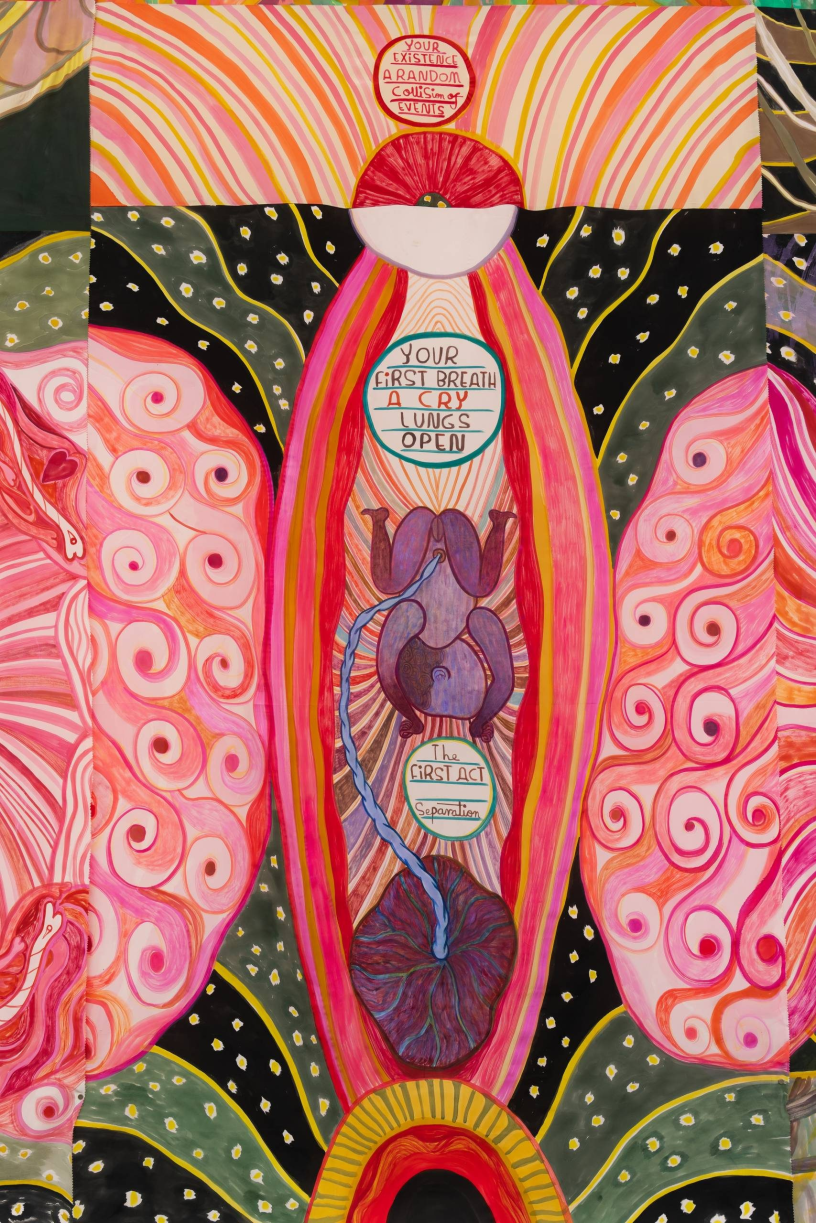
Visitors will first see an epic series of silk paintings, The Human Experience (2023), which will wrap around the gallery. Charting the momentous events of birth and death, and how we navigate what happens in between, these multi-part monumental works will immerse visitors in Talbot’s world, filled with stylised figures and organic landscapes. Opening by posing the question ‘What is the human experience?’, the series follows a life from fertilised egg to ageing figure in a world buffeted by storms, with natural disasters representing both physical and personal turmoil, and suggesting possibilities for better ways of existing.

Detail, The Human Experience (Death) at Kunsthall Stavanger. Courtesy the artist & Kunsthall Stravanger
Talbot’s work is highly personal, entwined with her own reflections on events in her life, such as becoming a widow and subsequently a single parent of two sons. These personal aspects sometimes collide with the wider political context, as can be seen in the major new installation The Tragedies (2024) in its UK debut.
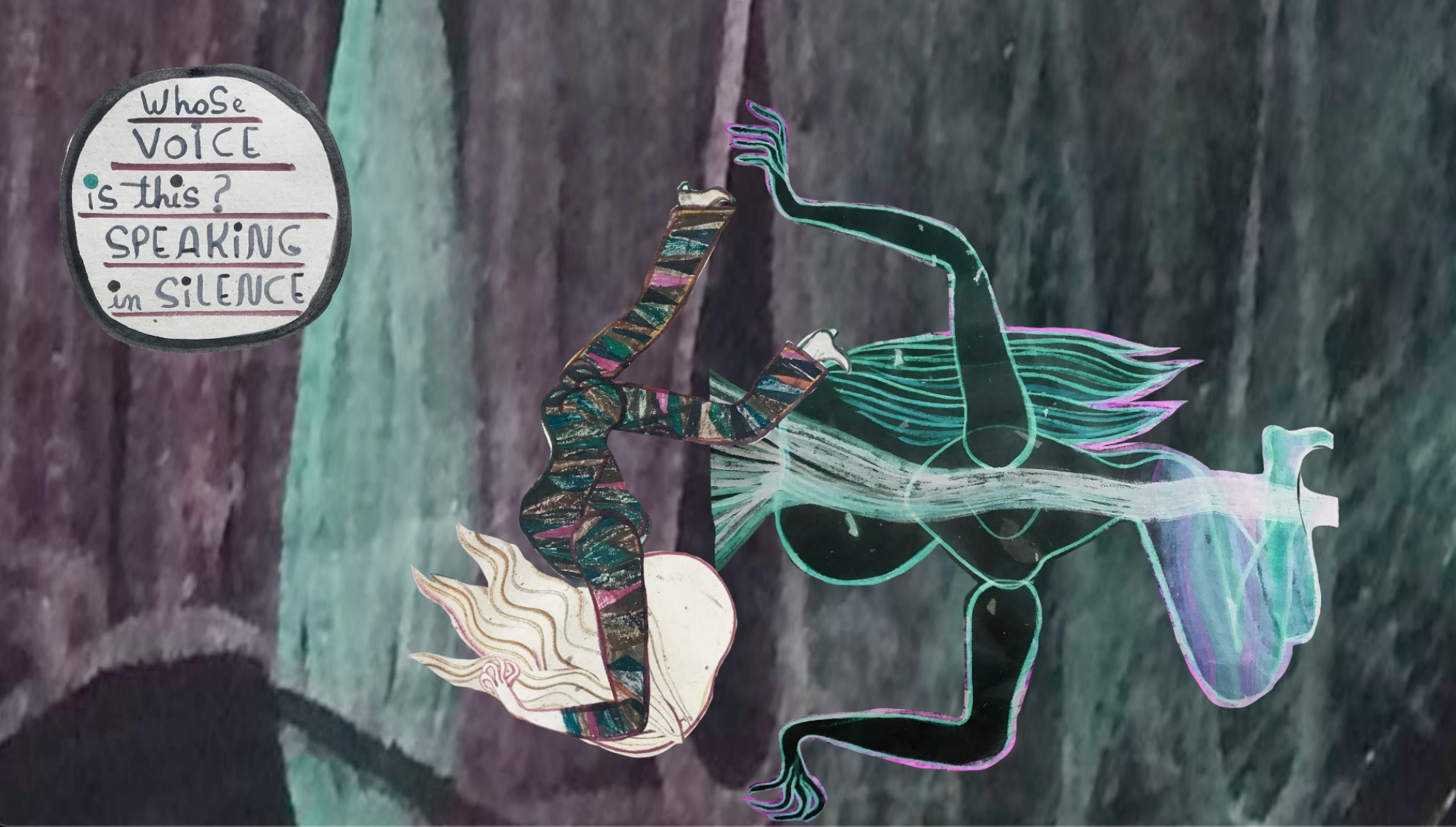
Detail, Emma Talbot, All That Is Buried, 2020, animation. Courtesy the artist
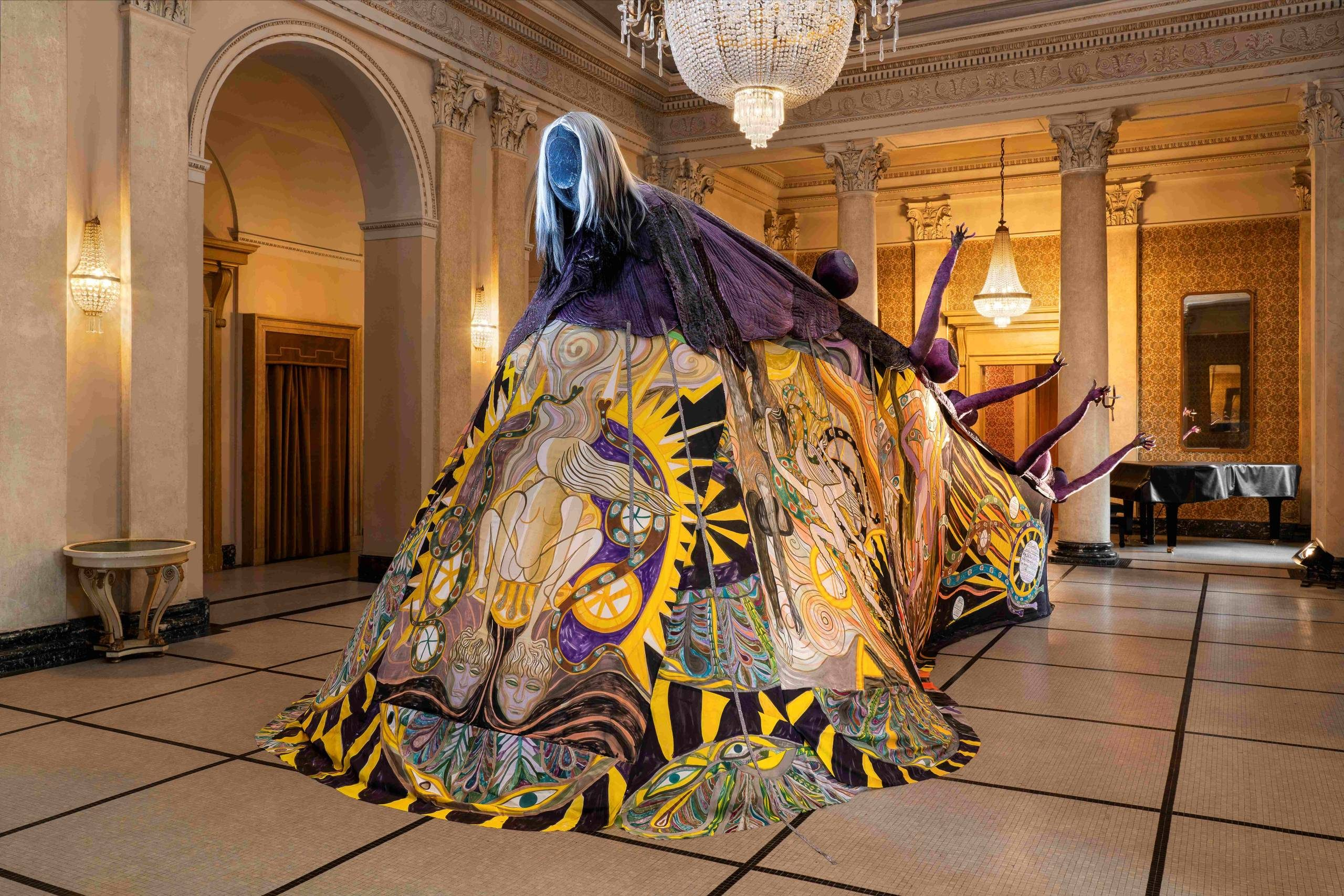
Huge in scale and packed with detail, combining silk paintings and sculptures from fabric, the work is inspired by the legend of Medea, who killed her two sons in an act of revenge against the Greek hero Jason. On the outside of the work the mother is shown in a terrible image, holding the heads of her two sons aloft in-front of a watching chorus audience. On the inside of the work, text and skeletal forms combine to reference contemporary tragedies, from the Russian invasion of Ukraine to discussions around conscription in the UK. The work poses questions about the lengths to which people will go to maintain control, even if this means sacrificing the ones they love.
Other sculptural works investigate humanity’s present relationship with nature. No Shade (2021) depicts a recoiling female figure in the harsh rays of the sun, constructed using both modern and traditional techniques including digital knitting processes. In Gathering (2023), fabric, beads and wood are used to depict a pink-haired figure grappling with vegetation and a serpent reflecting the layers of symbolism we attach to certain animals as well as the more threatening aspects of the natural world, while Rootless Plant (2023) recalls pagan deities with a multi-armed figure sprouting leaves.

Further silk paintings from Talbot’s recent body of work Magical Thinking (2023) will also be on display. These works are concerned with the ways in which humans use imagination to understand and describe the world. The use of this material, which is both exceptionally light but also very strong, lends an ethereal quality to Talbot’s dream-like worlds. New watercolour drawings will be shown, from those that developed to larger and grander works, to the ones that remained as they are. They are made on hand-made paper that contains vestiges of the raw material that was used in the process, such as bark and leaves. The series of drawings will show how Talbot works intuitively, creating free-form designs from whatever is at the forefront of her mind in that moment.
Another medium Talbot uses is animation, where sound and images come together for highly immersive works that emphasise the sense of movement and energy present in all her free-form output. All That is Buried (2020) shows a drawn figure navigating a soulless urban landscape in the pursuit of truth. Keening Songs (2021) references ancient modes of communication inspired by the ancient Celtic tradition of ‘keening’, a funerary rite involving singing to help recently deceased souls reach the next world. And in The Trials (2022), Hercules is re-cast as an elderly female figure inspired by Gustav Klimt’s painting The Three Ages of Woman (1905). With this animation, visitors will be able to view a key work that was a result of Talbot receiving the 8th edition of the Max Mara Art Prize for Women commission.
Near the end of the exhibition, the highly personal silk painting Grief Provokes the Most Profound Love (2023) brings Talbot’s exploration of the inextricable bonds between love and loss full circle, presenting a now-familiar protagonist – an avatar for the artist as well as a reflection of ourselves – that sheds their earthly form and returns to the earth.
Taking place in the region where the artist studied, Compton Verney’s showcase of these new and recent works will highlight why Talbot’s deeply personal takes on universal truths and mysteries are being sought after and celebrated around the world.
Emma Talbot said: “’How We Learn to Love’ brings together a number of key recent works, across different media, all exploring registers of the human experience. My work pieces together what is interior, personal and emotional with the issues and concerns of our times. As humans, we tell our own stories – and love is most often at the centre.”
Curator Oli McCall said: “It is hugely exciting for Compton Verney to be working with Emma Talbot on this ambitious show, which will introduce UK audiences to a host of new and recent works for the first time. Talbot’s work is deeply personal but also universal, touching on pressing issues of our times including societal power structures, ecopolitics, our relationship with the natural world and technology, methods of communication and the fragility of life, and often proposing better ways of living. The exhibition will offer visitors total immersion in Talbot’s dreamlike world, her ethereal silk paintings, delicate drawings, monumental sculptures and animations constituting a vibrant shifting landscape populated by stylised figures, mythical beings, plants and animals within which her themes can be explored.”
Compton Verney, Warwickshire, CV35 9HZ
 The Travel Locker