

Art Exhibition at Hastings Contemporary 27 September 2025 – 15 March 2026
A new exhibition of Sophie Barber’s work, the first in her hometown of Hastings.
Hastings Contemporary presents Mackerel sky, mackerel sky, never long wet, never long dry, a solo exhibition by British artist Sophie Barber (b.1996) in the town where she lives and works.
With intimate three-dimensional ‘cushion’ canvas paintings and large-scale works, Barber’s approach mixes humour and popular culture with folklore and the surreal, playing with the possibilities of scale, reference and materiality.
The exhibition will feature brand new works, alongside recent critically acclaimed work. Rooted in the landscape around her, Barber’s works are less depictions of her native Sussex coast than distillations of the impression it leaves. Her visual world is filled with echoes of her environment: bird shelters, tents, beaches, and the region’s ever-shifting skies.

Sophie Barber, Derek gave me flowers in the pouring rain, 2023. © Sophie Barber. Courtesy Alison Jacques
A childhood birdwatcher and carer for birds, avian life plays a central role in her imagery, connecting personal memory with environmental and cultural narratives.
In the new work made for this exhibition at Hastings Contemporary, Barber also returns to her long-held interest in the stories and structures of art history, and how this relates to her deep connection to the Sussex coastline. By referencing artists she admires, including Claes Oldenburg, Georgia O’Keeffe, David Hockney and Vincent van Gogh, Barber opens a dialogue between her own practice and theirs.
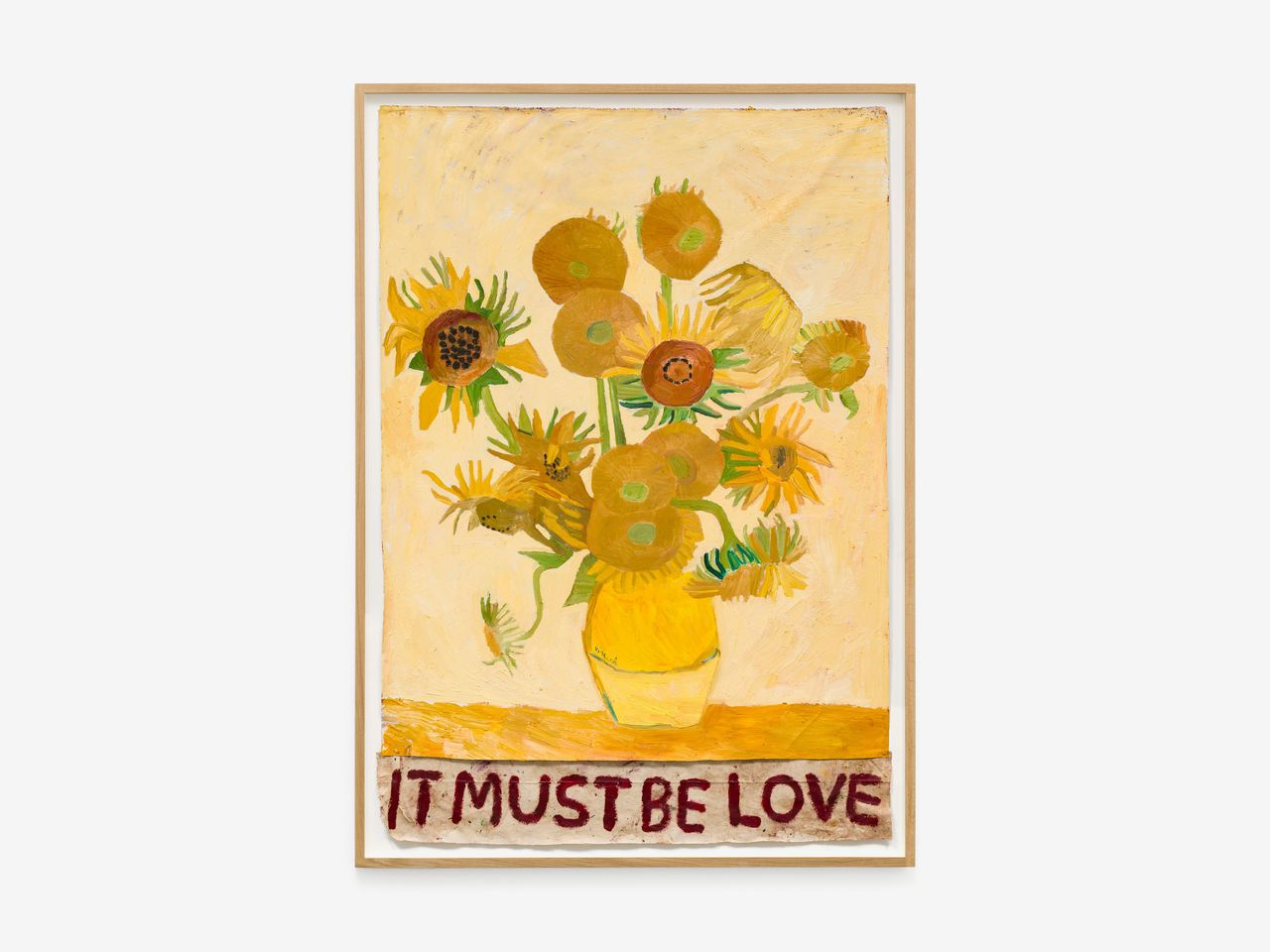
Sophie Barber, It Must Be Love, 2025, oil on canvas. Courtesy Alison Jacques © Sophie Barber
Sunflowers, a subject with a significant place in the history of painting, are a recurring motif in Barber’s new work in the exhibition. Alongside Van Gogh’s bold, emotional blooms, O’Keeffe’s studied, sculptural forms, and Hockney’s later, more reflective still lifes, Barber’s paintings explore the beauty and mortality that sunflowers have come to symbolise, adding her own take, shaped by the light and colour of Sussex.
As Barber has described: ‘It’s about singing from the same song sheet, but mine are a bit out of tune. I like the saying painting from life, isn’t it all painting from life, whether I’m painting someone else’s flowers they’ve painted from life or someone’s sculpture that already exists in the world, it still found me somehow and ended up in my life, otherwise I wouldn’t bother painting it.’
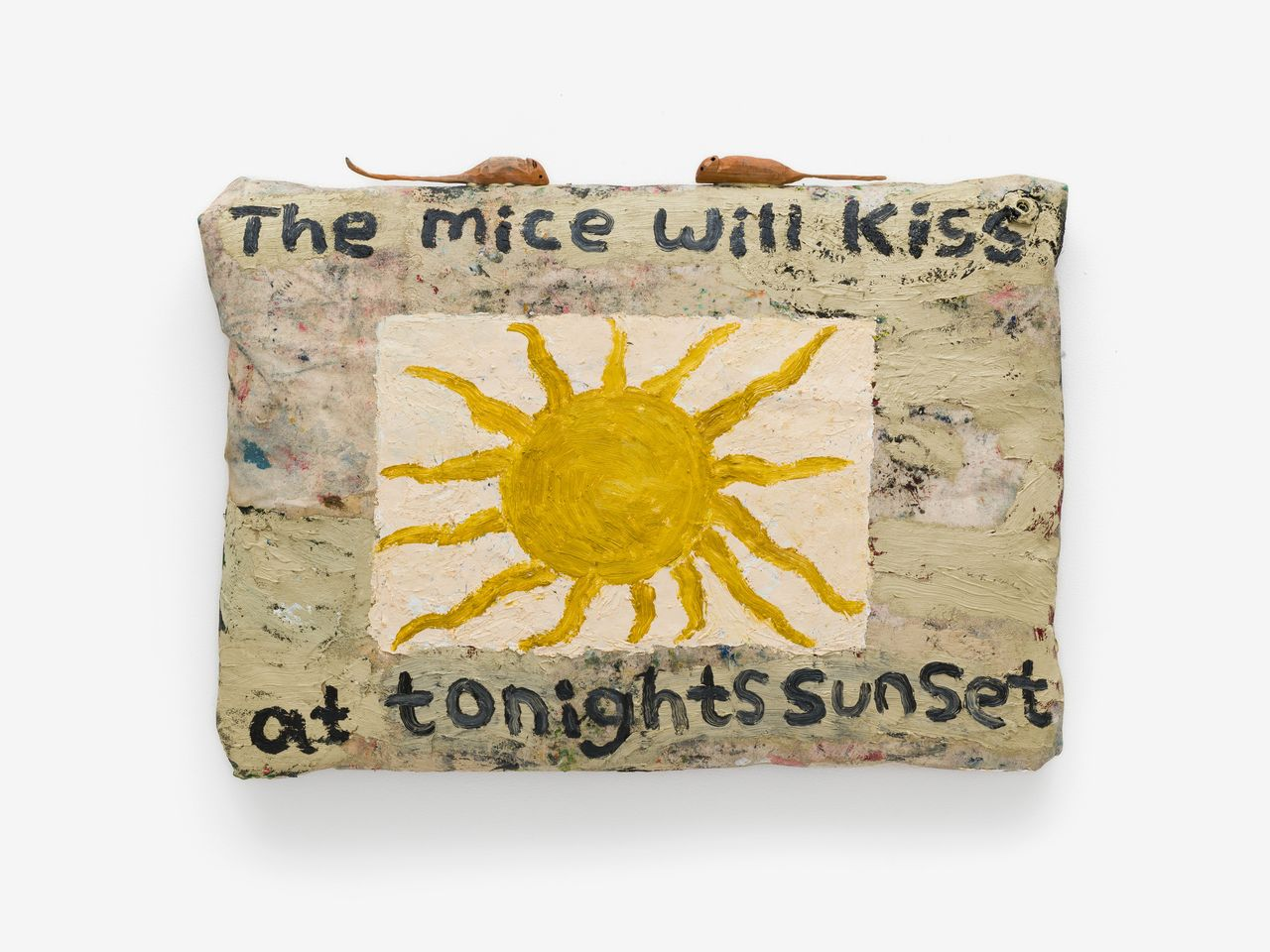
Sophie Barber, The mouse who was to marry the sun (Nezumi no Sumō), 2024, Oil on canvas, wood, © Sophie Barber. Courtesy Alison Jacques
This exhibition marks the first in Barber’s hometown of Hastings. Mackerel sky, mackerel sky, never long wet, never long dry brings together the local and the legendary, the past and the present, showcasing her experimental practice which uses painting as a way of getting close – to place, history, and the things that matter.
The exhibition will be accompanied by the first monograph of Barber’s work.

Sophie Barber. Credit Tom Jamieson New York Times Redux eyevine
A graduate of University of Brighton at Sussex Coast College Hastings, Barber has exhibited widely, with solo shows at Goldsmiths CCA (2020) and her two-person Painting Sculpture with Franz West at the Austrian Cultural Forum, London (2025). Barber’s work has been included in exhibitions at Green Family Art Foundation, Dallas, Texas (2024); Kasteel Wijlre Estate, Wijlre, Netherlands (2023); Lismore Castle Arts, Co. Wexford, Ireland (2022); La Maison de Rendez-vous, Brussels, Belgium (2020). Her work is on view in Sussex Modernism at Towner Eastbourne from May to September 2025.
Hastings Contemporary Director, Kathleen Soriano, says: ‘Hastings Contemporary has a history of showcasing exciting artists, such as Sophie Barber, at pivotal moments in their careers. In this exhibition, Barber’s work is strangely familiar in its lifting of motifs from famous artists and well-known paintings yet shocks us into the present day with her assertive use of colour and very personal additions of text.’
 The Travel Locker