
15 November 2025 – 4 February 2026
The Gallery at The Arc, Winchester
Hampshire Cultural Trust is proud to present the first ever exhibition to show how natural beauty inspired the radical imagination and art of the Morris family. The exhibition features designs by William along with work by his daughter May and wife Jane, plus artworks by other Pre-Raphaelite artists including Dante Gabriel Rossetti, John Ruskin, Edward Burne-Jones and Marie Spartali Stillman.
Beauty of the Earth will reveal how the Morrises’ love for gardens and green spaces was woven into all aspects of their lives, from patterns to politics. Their art is still beautiful, fruitful and radical.
The exhibition comprises more than 50 objects, with significant loans travelling to Hampshire from institutions such as the William Morris Society, Victoria and Albert Museum, Kelmscott Manor and the Ashmolean Museum, along with objects drawn from the collections of the British Library and private lenders. There will be ceramics, textiles, wallpapers, prints, personal items, books, poetry – demonstrating the variety of the media that the Morris family worked in.
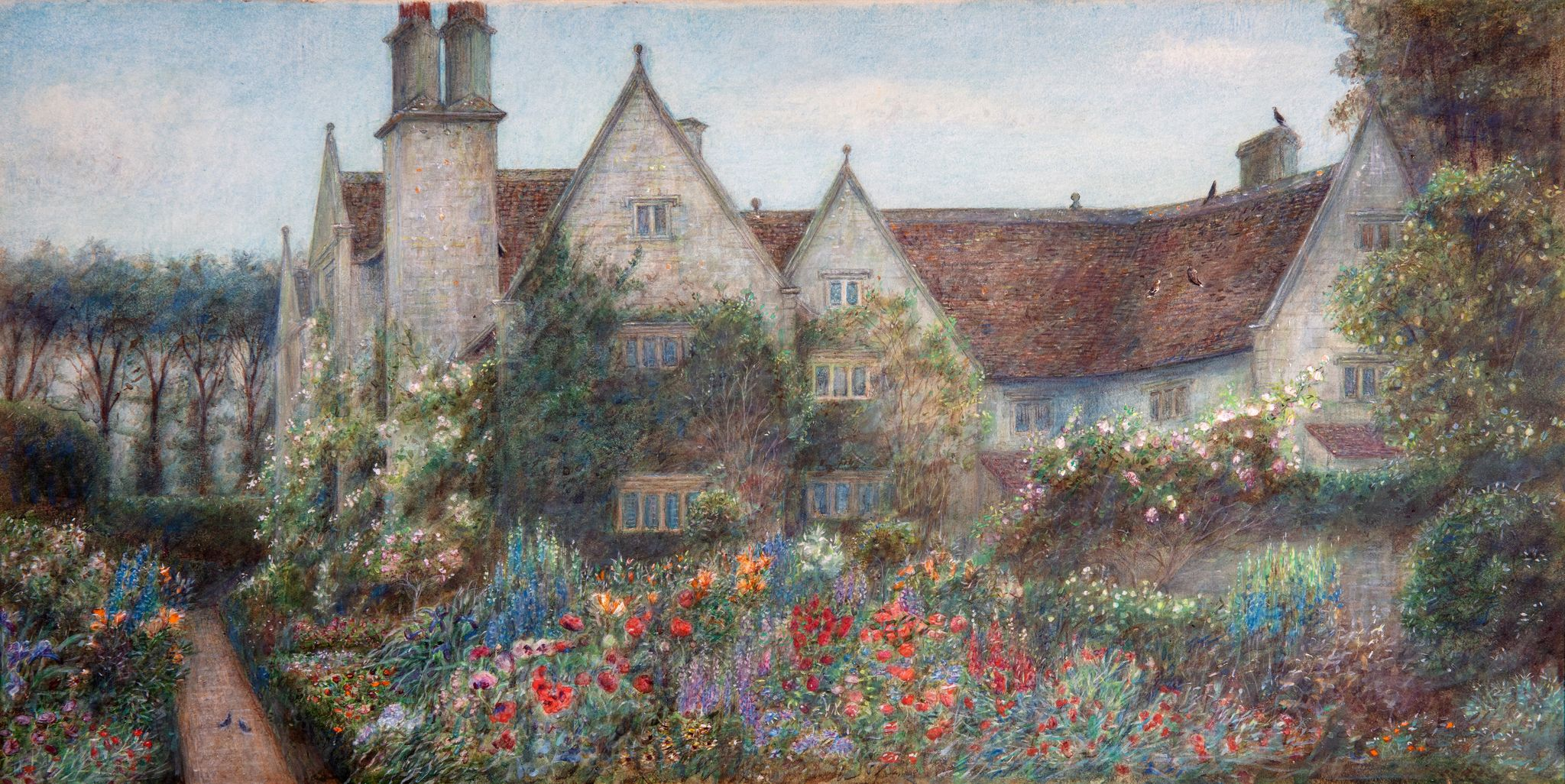
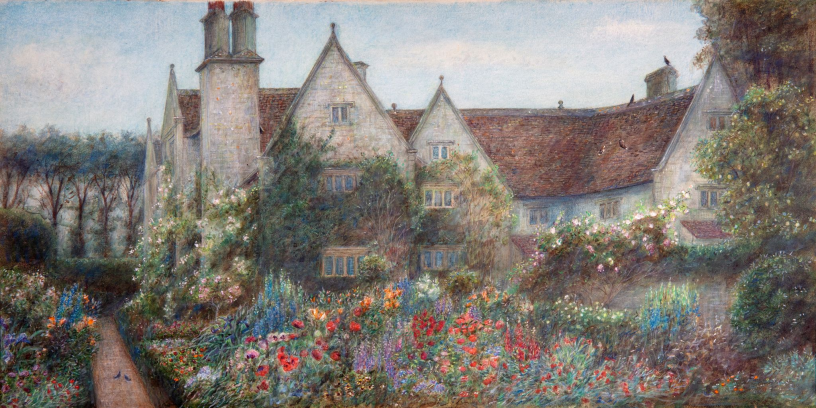
The Garden at Kelmscott Manor by Marie Stillman, 1905, watercolour © Society of Antiquaries of London (Kelmscott Manor)
Jane (1839-1914) and William Morris (1834-1896) made their homes into gathering places, where creativity was encouraged. From Red House in Kent, built for the newly married couple in 1859, to their holiday home at Kelmscott Manor in Oxfordshire, the couple and their friends found inspiration in the gardens, orchards and hedgerows nearby. They celebrated blossom-time and fruitfulness, as many of the objects in the exhibition evocatively demonstrate.
Among the many highlights, the exhibition features a number of items made by Jane and May, that have rarely been seen before, including colourful watercolours, embroideries and miniature books.
“We are able to display fragile textiles, original photographs and delicate works on paper, to tell unexpected stories about the women and men who shaped the Arts and Crafts movement,” says Suzanne Fagence Cooper, Guest Curator. “Beauty of the Earth seeks to reposition Jane Morris and her contributions artistically alongside William, at the heart of the household and their circle.”

‘Orchard’ bed curtain designed by May Morris for William Morris’s bed at Kelmscott Manor. Embroidered in wool thread on a wool ground, 1891-3 © Society of Antiquaries of London (Kelmscott Manor)
The displays will also demonstrate how sensitivity to natural beauty was central to William Morris’ work. His designs for the home, his lyrical poetry, even his political activism, were all underpinned by his care for the landscapes he cherished. Indeed, Morris once said that he hoped everyone could enjoy “possessions which should be common to all of us, of the green grass, and the leaves, and the waters, of the very light and air of heaven” and urged us all to “love the narrow spot that surrounds our daily life.”
The exhibition will feature a specially commissioned sound piece of the sounds of Kelmscott Manor – connecting to the ecology, experience and landscapes of the charming 17th century house that Morris described as “heaven on earth”.
One of the most arresting pieces on display is Blanzifiore (Snowdrops) by Dante Gabriel Rossetti (1828-1882). Painted in 1873, this stunning portrait of Jane Morris, which is rarely publicly shown, appropriately forms the centrepiece of Beauty of the Earth. It depicts Jane as a beautiful, thoughtful and beloved real woman, rather than a mythological figure or goddess.
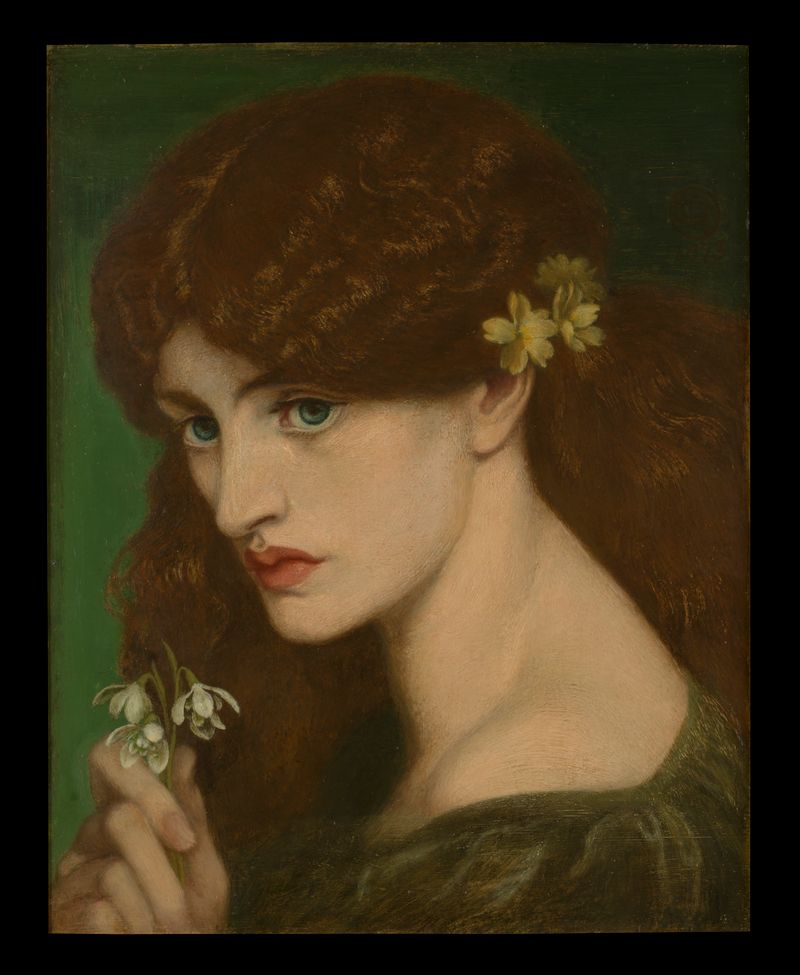
Blanzifiore (Snowdrops) by Dante Gabriel Rossetti (1828-1882) © Private Collection
The intriguing Book of Verse,containing poems and calligraphy by William Morris, also features decoration by Edward Burne-Jones (1833-1898), Charles Fairfax Murray (1849-1919) and George Wardle (1836-1910). Hand written, exquisitely bound and gilded, it was made in 1870. The book is a collection of Morris’s original poems and translations from Icelandic given to Georgiana Burne-Jones (1840-1920), Edward’s wife. It highlights the importance of collaboration between the artists in the circle.
The exhibition is timed to coincide with the winter closure of Kelmscott Manor. This has enabled the loan of a star object, a large and complex tapestry, Acanthus and Vine (1879-1881). Designed and woven by William Morris himself as an experiment, it demonstrates Morris’ creative versatility and how he revived the ancient technique of tapestry weaving. Created from wool and silk, the piece features birds eating grapes, symbolising fruitfulness and the natural world.
Among a selection of rarely seen objects are three keepsake books designed and made by Jane Morris (circa 1880 to 1914). These small, highly personal books have never been seen in public before and were created by Jane variously as Christmas gifts or as a record of favourite quotations and mottoes.

Windrush design, William Morris © William Morris Society
“Often overlooked for her own accomplishments, Jane Morris was far, far more than just an artist’s model. The most significant works to show her own independent skills and character, are these keepsake books,” says Suzanne Fagence Cooper. “They show the range of her reading, with passages in medieval French, Italian, Middle English and Greek, these intimate objects embody Jane’s personal growth from her origins as a servant in Oxford. Above all, the design and production of these books demonstrate her talent, in their idiosyncratic visual vocabulary.”
A series of botanical studies, including Yellow Horned Poppy and Honeysuckle, made by May Morris in the 1880s, show how closely William and Jane’s daughter observed the natural world. She studied at the National Art Training School in South Kensington, where she specialised in embroidery, but later became a wallpaper and jewellery designer, writer and lecturer. Many of these watercolours have never been exhibited before. Some of them relate to wallpaper patterns that she designed for Morris & Co. These have been specially conserved and framed for the exhibition.
Reflecting the lifelong influence of the great polymath John Ruskin (1819-1900) on William Morris, the exhibition includes A Wild Strawberry Plant (1873), a detailed study that is also emblematic of Ruskin’s own abiding fascination with the natural world.
A glimpse into the family’s homelife is afforded by Recipes from Kelmscott Manor, collected and written by Jane Morris from the 1880s until 1910. Jane passed a folder of family recipes on to her daughters Jenny (1861-1935) and May. They show how their mother collected notes about favourite dishes she had discovered on her travels or when visiting friends. They also include recipes to make use of fruit and vegetables from their gardens. Jane’s recipe for bread, probably written when May was preparing to get married, reveals how even simple domestic tasks can be beautiful. Many home bakers will recognise Jane’s advice: “It takes some practice to make the loaves round and shapely.”
Perhaps one of the most personal objects in the exhibition is Daisy curtain(circa 1860), which was designed and stitched by Jane and William. It was one of the first projects that they made together shortly after their marriage in 1860. Jane found the dark blue backing material, and William adapted the daisy design from a 15th century manuscript.
Beauty of the Earth: The Art of May, Jane and William Morris celebrates the creative powerhouse family at the heart of the English Arts and Crafts movement. It shines a spotlight on their values of collaboration and desire to share their skills and radical vision at home, with friends and with the wider world.
The exhibition has been selected by guest curator Suzanne Fagence Cooper, one of the world’s leading William Morris experts, who says: “William Morris, Jane and May lived fruitful, fascinating lives. Their love of green and growing things underpinned their desire to defy conventions. They still encourage and challenge us now.”
LIKE this Please consider giving thetravellocker a FOLLOW on Facebook, Twitter and Instagram.
Thank You
 The Travel Locker