
Compton Verney – 25 October 2025 – 22 February 2026
This autumn, Compton Verney – recently a finalist for 2025 Art Fund Museum of the Year – will stage an ambitious exhibition that explores storytelling as a fundamental part of human existence and asks whether sharing stories can help to heal in fractious times.

Mexican animal model © Compton Verney photo by Ken Adlard
Over 100 objects will be brought together to chart the relationship between storytelling and belonging. Works by icons of modern and contemporary art will feature, including Paula Rego (1935-2022), Wassily Kandinsky (1866-1944), Hew Locke (b.1959), Do Ho Suh (b.1962), Yinka Shonibare (b.1962), and Kiki Smith (b.1954), alongside historic works and objects from the Bodleian Library, the British Museum, the Pitt Rivers Museum and Compton Verney’s own collection.

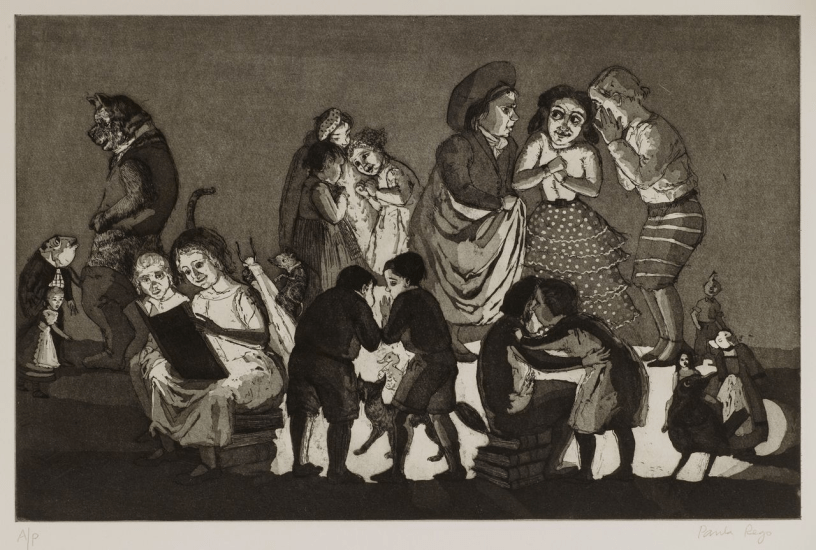
Secrets and Stories, 1989 © Paula Rego Estate & Ostrich Arts Ltd. Courtesy Ostrich Arts Ltd and Cristea Roberts Gallery
Co-curated with celebrated writer and cultural historian Marina Warner, the exhibition follows the release of her critically acclaimed book Sanctuary: Ways of Telling, Ways of Dwelling which explores travelling tales and the way myths, stories and works of art can foster togetherness across cultures and create a sense of belonging.
The exhibition is also being designed by leading curator, art director and designer Simon Costin, Director of the Museum of Witchcraft and Magic, Boscastle, and the Museum of British Folklore, and who designed the critically acclaimed Making Mischief exhibition at Compton Verney in 2023.
Since the earliest known records of human history, there have been stories. Classic tales such as the Epic of Gilgamesh and The Iliad and stories from Christian, Muslim and other religious material, have been reworked and reinterpreted through the storytelling and entertainment outlets of the day, with plays, board games and story machines joining the more recent narrative arts.
The Shelter of Stories will feature a huge array of such media, from puppets, masks, paintings, sculpture, film and dioramas, toys, signs and games. Presented across a suite of galleries at Compton Verney, the works and objects on show will unfold three interrelated functions of stories: to help us face fears in order to withstand them, to show us how to live in harmony with nature, and to pass on wisdom and strengthen hope.
The exhibition draws on the work of Stories in Transit, a storytelling initiative which Warner co-founded in Palermo, Sicily, working with people newly arrived across the Mediterranean, from Asia, North Africa and the Middle East. The exhibition takes place as the most recent United Nations High Commissioner for Refugees (UNHCR) figures show over 123.2 million people were forcibly displaced worldwide by the end of 2024, the highest-ever number on record.
A central thread running through the exhibition will be Marina Warner’s proposal that sanctuary can come from the telling of such tales, where Aesop’s Fables and medieval Arabic tales mingle and provide a different type of shelter beyond the physical. Sanctuary has never just been about bricks and mortar, but exists as a right and process, as far back as at least Ancient Greece with the concept of xenia.
Through works of art and objects, the exhibition will investigate whether stories can provide this different type of shelter, where fugitives, refugees and displaced peoples can build connection through inventing, listening and re-working stories.

In Other Worlds Acts of Translation_Focal Point Gallery Install 2025_100dpi_Anna Lukala
Two works by Yinka Shonibare (b.1962) powerfully explore the concept of sanctuary with handmade miniature versions of real buildings. Sanctuary City (Temple of Athena Nike) (2024) and Sanctuary City (Johnson House) (2025) are painted black, appear silhouetted in the space but emit a warm, welcoming glow from within. The first references followers of Cylon, an aspiring ruler of Athens in the 6th century BC, who fled to the temple of Athena on the Acropolis as political fugitives. The latter references the Quaker abolitionist house which during the 19th century worked with other European and African Americans – free and enslaved – to secure safe passage through the Underground Railroad.
Also included will be a multimedia installation by Lebanese artist Mounira Al Solh (1978) which will greet visitors in the first part of the exhibition, as she draws inspiration from the cedar tree and its importance to the history and people of her country. Four embroidered textiles will hang from the ceiling evoking the Lebanis Cedrus tree. Phoenician and Arabic letters will be silkscreened on, referencing the previous exploitation of Lebanon’s resources by various cultures. Through this work, she will tell a story of a tree that connects us across two-thousand years, from Gilgamesh to present-day rulers, and the dangers that confronted both our ancestors and us.
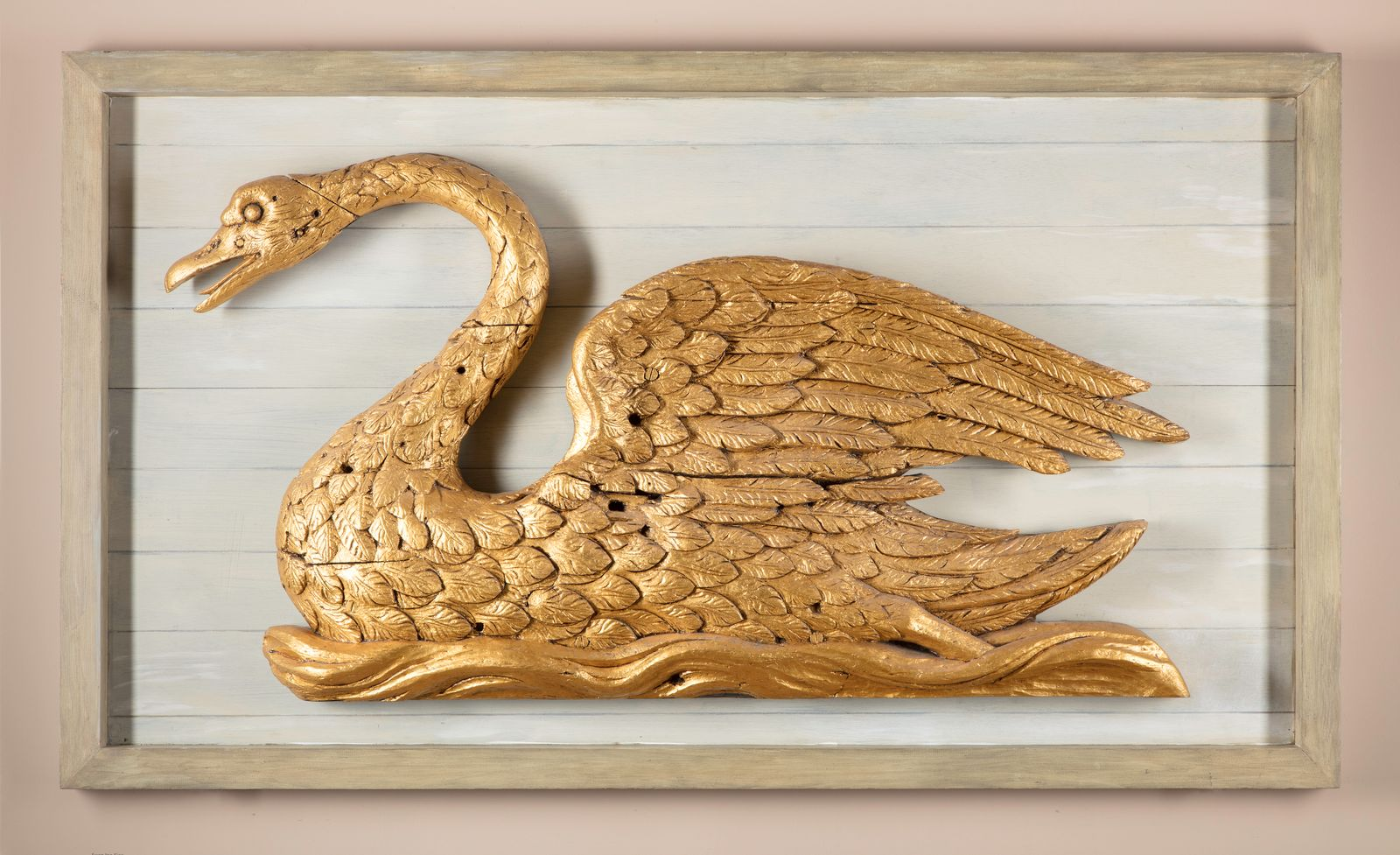
Unknown maker, Swan Public House Sign, 1700-1750. Photography by Jamie Woodley (c) Compton Verney and Jamie Woodley
This work will be in dialogue with Paula Rego’s atmospheric etching Encampment (1989). It depicts a group of adults and children huddled around campfires and tents telling stories. Storytelling is a central theme within Rego’s work, often drawing on the oral folk tales of her native Portugal. Other objects in this part of the exhibition include historic Sicilian marionettes depicting knights in shining armour on loan from Pollock’s Toy Museum, as well as an array of other puppets of witches and deities and masks, from Punch and Judy to the Yoruba Egungun rituals, conveying the creative methods storytellers have used to enrapture their audiences across the centuries.
Following his recent addition to Compton Verney’s Sculpture in the Park, Hew Locke returns with a textile work from his series Call Sign (2019), drawing on the identifying codes of boats which have been involved in rescuing migrants at sea in these hostile and troubled times.
Throughout human history stories have helped people face their fears and this has given rise to myriad forms of fantastical creatures, heroes and villains. In the second section of the exhibition Jonathan Baldock’s Pa Ubu (2015) holds court. The work takes the form of a giant puppet, referencing the long tradition of puppetry in storytelling, and inspired by Alfred Jarry’s absurdist play depicting a despotic yet infantile ruler. This is joined by works from Marcelle Hanselaar’s series Rebel Women of the Apocrypha (2023-) which re-considers women vilified in Biblical tales, and the painting Lot and His Daughters (c.1530) by Lucas Cranach the Elder, from Compton Verney’s collection.
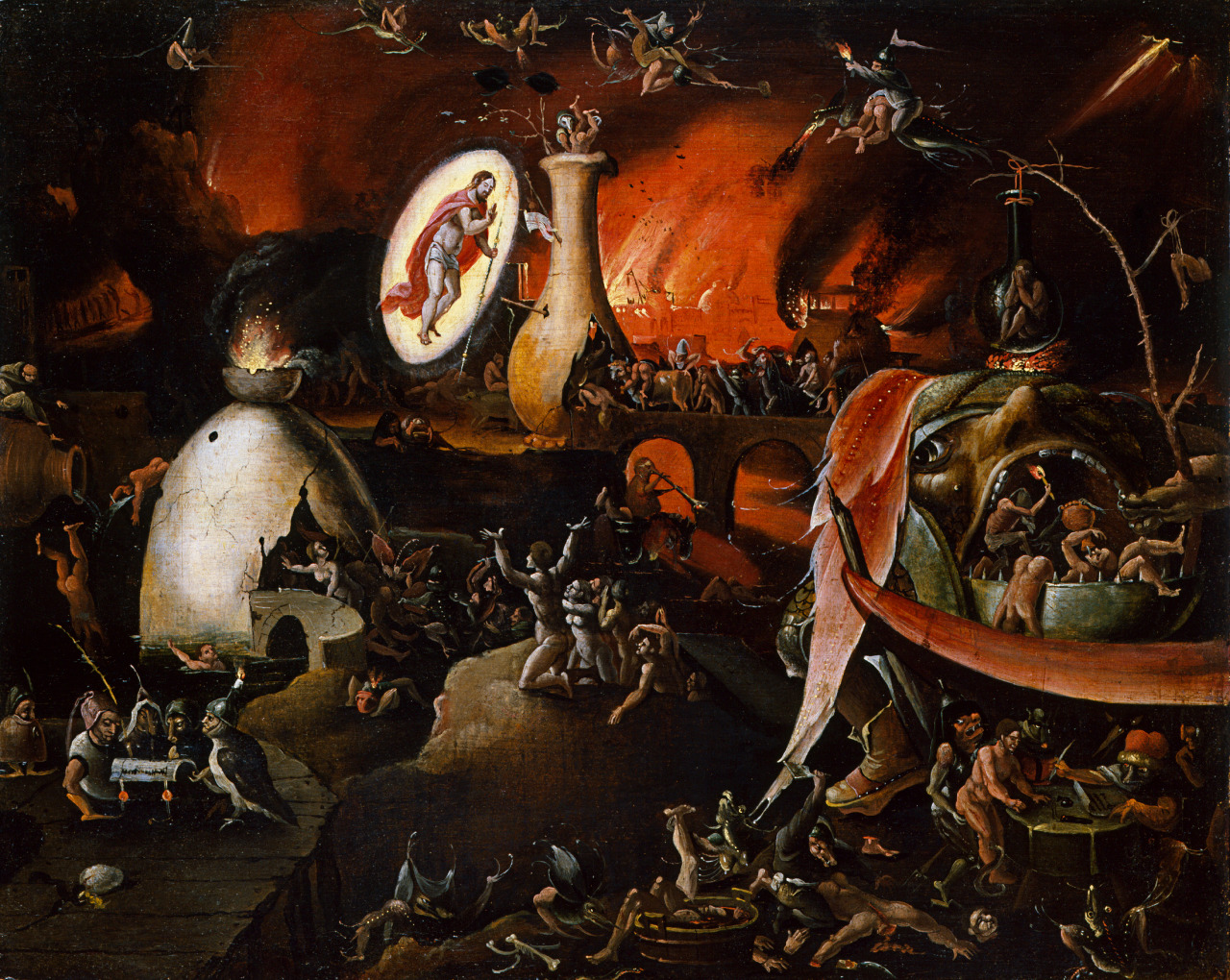
N Huys, Pieter – The Descent into Limbo © Compton Verney
Russian pioneer of abstraction Wassily Kandinsky also features with a linocut print of an extravagantly dressed female figure peering into a mirror referencing his love of folklore, Der Spiegel (1907), from the British Museum. There is also an incredible illustrated boardgame based on Red Riding Hood from 1910 from the Bodleian Library, demonstrating how the use of games also becomes a medium for passing on stories, as well as cautionary aspects of the tale. And one of the most famous and influential stories in human history, the Epic of Gilgamesh, which turns on the heroes’ sacrilege when they kill the guardian of a sacred forest and learn the meaning of death, is the subject of German illustrator Monika Beisner’s (b.1942) long-running series, depicting the hero‘s passage to the Underworld.
Animal fables and stories relating to the natural world are among the oldest in existence. A selection of six prints from South African-born artist Susan Moxley’s (b.1960) Baghdad Series depicts jugglers, turtles, weasels and elephants amongst other animals in bright colours, and is based on a 13th century manuscript from Baghdad used to educate young princes via moral lessons and animal characters. Also on display is Sojourn (2015) a large jacquard tapestry by leading contemporary artist Kiki Smith using glitter, coloured pencil, watercolour and a host of printed materials that shows a fox moving through undergrowth. Also on display are objects from Compton Verney’s collection including an 18th century public house sign in the form of a folk-tale golden swan, and etchings by two turn-of-the-century greats, with Paul Klee’s (1879-1940) enigmatic Weib und Tier (1904) depicting an androgynous figure leading a gazelle-like creature, as well as Heinreich Vogeler’s fairytale inspired by The Seven Swans (1898) printed on Japan paper.
Stories have also been a way that local and national history is recorded, as well as the lessons learned. On display will be contemporary artwork that deals with how different cultures have traced these lessons and informed future generations. Be Aware (2022) is a series of carved and painted wooden relief sculptures by Brazilian artist Ana Maria Pacheco (b.1943) drawing inspiration from the seven deadly sins. Stella by Starlight (2013), a sculptural work by Zak Ové (b.1966) made from vintage hi-fi equipment with an African face mask, is inspired by the traditions and rituals of Trinidadian carnival that use dance and music to pass on wisdom and identity. This joins a selection of 20th century masks by unknown makers from Nigeria, Côte d’Ivoire and Mexico, on loan from the Pitt Rivers Museum.
The exhibition will be accompanied by a curated programme of public events. Communal story-making will be celebrated with workshops combining masks, puppetry, song, and movement that will culminate in a winter procession through the grounds.
Marina Warner said: “The ingenuity and variety of storytellers’ methods have made this show a total joy and adventure to research and select. Compton Verney, with its collection of paintings and folklore, and its swans on the lake, makes a perfect setting for a show about the commons of wonder.”
This exhibition is kindly supported by ARTscapades.
 The Travel Locker
I enjoyed reading your introduction to the forthcoming exhibition The Shelter of Stories. Just one one point: Gilgamesh went to the ends of the Earth, not the Underworld. Is it too late to change?
LikeLike
I have passed your comment on to Compton Verney for consideration. Thank you
LikeLike